FTC Affiliate Disclosure Rules for Bloggers in 2026, in Plain English
Disclosure: MakeBlogAI may earn a commission from some links on this site; this article contains no paid or affiliate links. It was researched and drafted with AI tools and checked by a person against the primary sources linked below. General information only — not legal, tax, or financial advice, and no income is promised or implied.
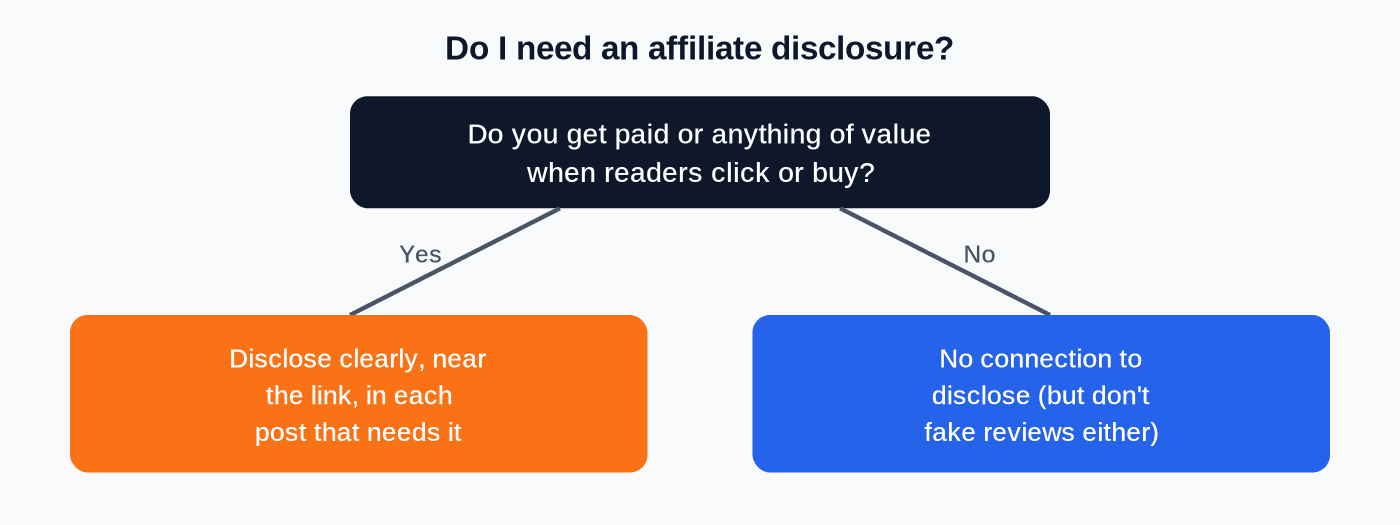
The short answer: If you earn a commission from links, the FTC expects you to disclose it clearly and conspicuously, close to the recommendation, in every post where it applies. Plain wording works.
The FTC’s own example is “I get commissions for purchases made through links in this post.” The FTC says the phrase “affiliate link” on its own is one consumers “might not understand,” and a disclosure only on your home page or behind a link isn’t enough.
Where these rules come from
The FTC’s Endorsement Guides (16 CFR Part 255, revised in 2023) and its staff Q&A, “FTC’s Endorsement Guides: What People Are Asking”, explain how truth-in-advertising law applies to endorsements. The FTC says the Guides “don’t have the force of law” by themselves, but “practices inconsistent with the Guides may result in law enforcement actions” under Section 5 of the FTC Act.
The staff Q&A also says it “doesn’t provide a safe harbor.” Context still matters.
The coffee-blogger example
The Guides include an example of a blogger who reviews coffee makers independently and earns “a portion of the sale” through affiliate links. Because that compensation “could affect the weight or credibility” readers give the reviews, “the reviews should clearly and conspicuously disclose the compensation.” That example describes most AI-tool and side-hustle blogs.
Wording that works, and wording that doesn’t
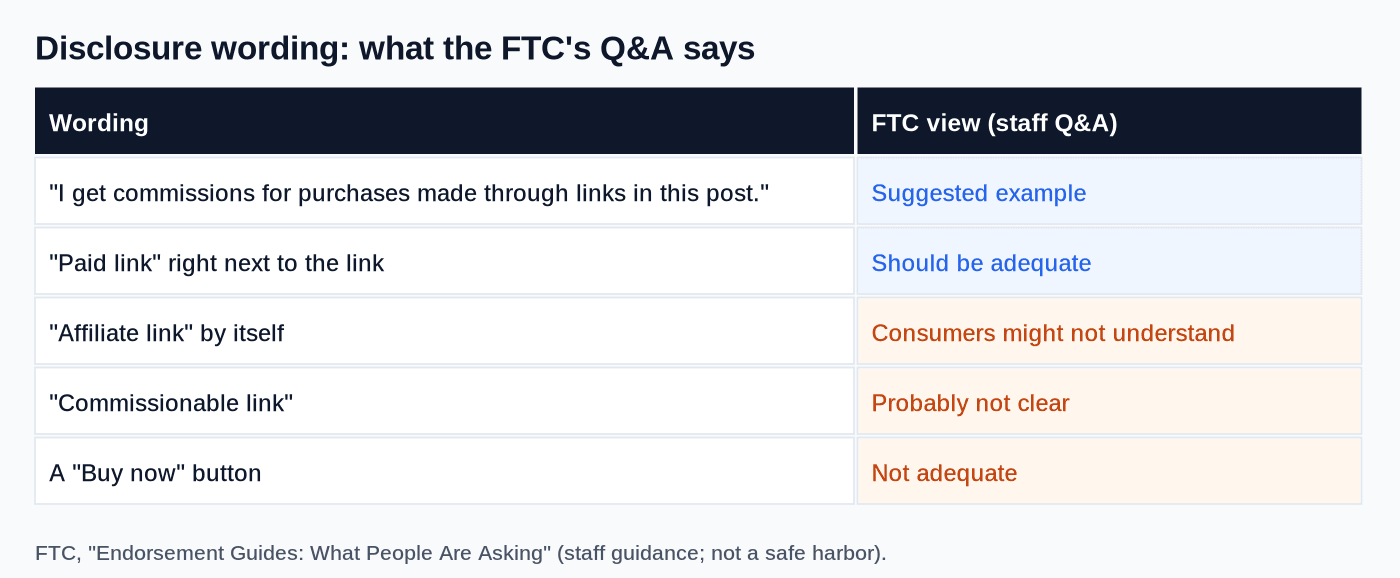
The FTC Q&A answers several wording questions directly:
- Suggested: “I get commissions for purchases made through links in this post.”
- “Paid link” placed “right next to an affiliate link should be an adequate disclosure.”
- “Affiliate link” by itself: “Consumers might not understand that ‘affiliate link’ means that the person placing the link is getting paid.”
- “Commissionable link”: “probably not a clear disclosure.”
- A “buy now” button: “would not be adequate.”
You don’t need a lawyer or special language. The Q&A says “the point is to give readers the essential information in words that are easy to understand.”
Where to put it
The FTC’s answer for blogs is specific. Readers “might overlook a disclosure at the very top of the page, outside of the blog,” and “may miss a disclosure at the bottom.” A disclosure “is more likely to be seen if it’s very close to, or – even better – part of, the endorsement to which it relates.”
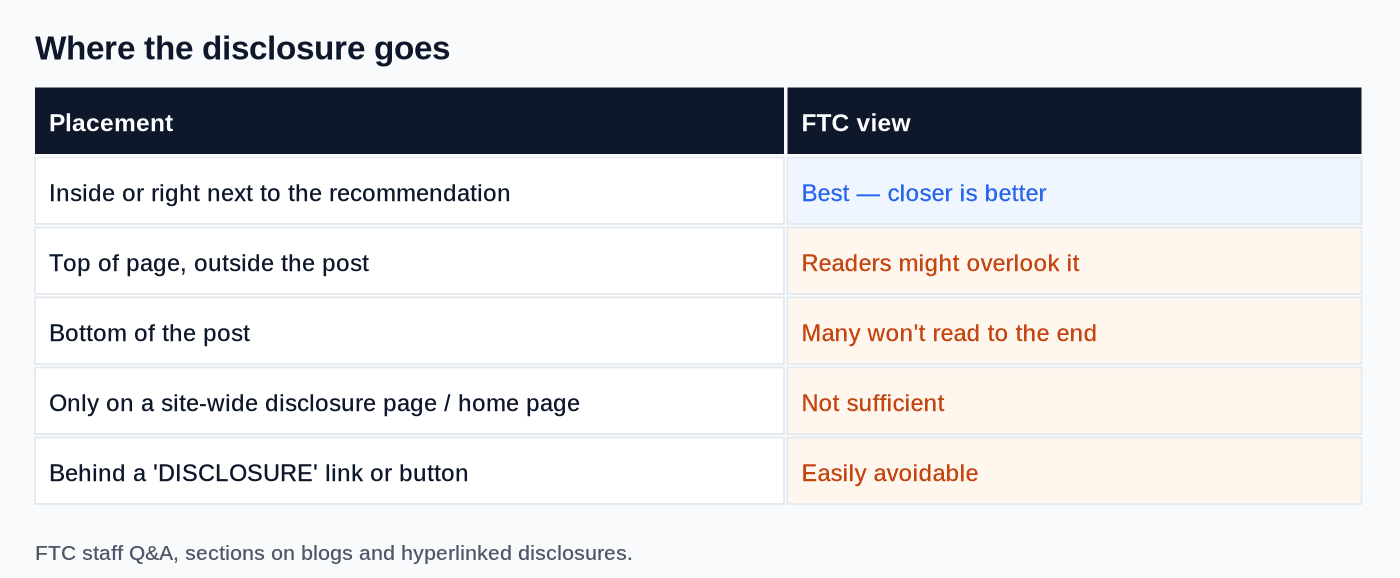
- A site-wide disclosure page isn’t enough. The FTC says a single home-page disclosure “won’t be sufficient because people visiting your site might read individual reviews… without seeing” it.
- Hyperlinked “DISCLOSURE” buttons don’t count. They’re “easily avoidable.”
- One disclosure can be enough when the reader can see the disclosure and the link at the same time. If the link is far from the disclosure, “readers may not make the connection.”
It’s not only commissions
The same principle covers free products, free trips, loaned items and other perks. The FTC’s examples include a blogger flown to a product launch, who should disclose “free travel and accommodations.” If an AI company gives you a free annual plan to review, say so.
Video and social posts
If you also post on YouTube, the FTC says a disclosure only in the description is “not enough on its own.” Put it in the video itself, ideally both on screen and spoken. Affiliate links in a video description need the disclosure “both in the videos and in the description near the links.”
Honest reviews matter too
Disclosure doesn’t fix a dishonest review. The FTC Q&A says “You can’t talk about your experience with a product if you haven’t tried it,” and you can’t call a mediocre product great. On AI-income blogs this matters especially, because results claims (“I made $X with this tool”) have to reflect what’s typical or include clear context.
A routine for every post
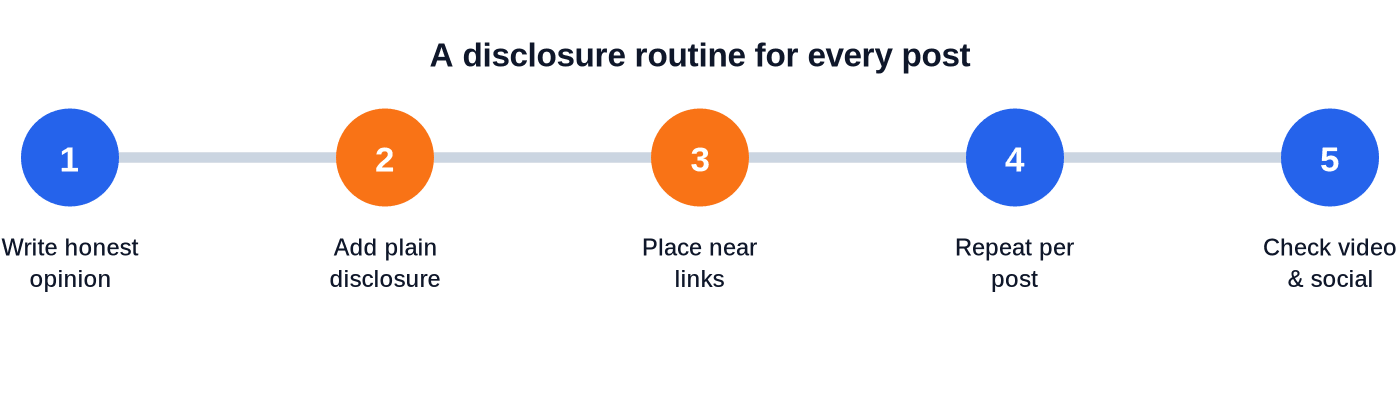
- Write your honest opinion, based on what you’ve actually used.
- Add a plain-language disclosure, such as “We earn a commission if you buy through links in this post.”
- Place it near the first affiliate link, and add “(paid link)” next to individual links in long posts.
- Repeat it on every post that has affiliate links.
- Disclose in your videos and social posts too.
How MakeBlogAI does it
Every article has a disclosure box above the first paragraph. Any post with affiliate links states it plainly there and marks the links near where they appear. Articles with no paid links, like this one, say so.
Copy-and-adapt disclosure examples
| Situation | Example wording |
|---|---|
| Post with affiliate links | “We earn a commission if you buy through links in this post.” |
| Next to a single link | “[Product name] (paid link)” |
| Free product to review | “[Company] gave me [product] to review.” |
| Free trip or event | “[Company] paid for my trip.” |
| Paid sponsored post | “This post is paid for by [brand].” |
These are modeled on examples in the FTC staff Q&A. Adjust them to your actual relationship.
Labels the FTC says are unclear
- “#endorsement”: it “doesn’t make clear” that you were paid.
- “#ambassador” or “partner” alone: “ambiguous and confusing.” The FTC says “#XYZ_Partner” with a brand name is better.
- “Gifted” without a brand: “likely to be ambiguous.”
- Just thanking the brand (“thank you, XYZ”): doesn’t communicate that you got something.
- Tagging a brand: “it’s not a disclosure that you have a connection.”
Results claims on income blogs
The FTC Q&A says that when endorsements claim specific results, statements like “Results not typical” or “Individual results may vary” won’t change how people read them. Advertisers need proof the results are typical, or must clearly disclose what people can generally expect. For AI-income content, that means not presenting someone’s best result as normal, and not publishing income claims you can’t back up.
A pre-publish checklist
- Does this post contain any affiliate links, sponsored items or free products? List them.
- Is there a plain-language disclosure before the first affiliate link?
- Are individual links far from the disclosure marked “(paid link)”?
- Have I actually used every product I recommend?
- Are any income or results claims typical and backed up?
- Do the linked video and social posts carry their own disclosures?
FAQ
Do I need an affiliate disclosure on every post?
Yes, on every post that has affiliate links or other material connections. The FTC says a single home-page disclosure isn’t enough.
Is “this post contains affiliate links” enough?
The FTC says “affiliate link” alone might not be understood. Say plainly that you earn a commission, as in the FTC’s example: “I get commissions for purchases made through links in this post.”
Where should an affiliate disclosure go?
Close to the recommendation and links, ideally part of it. The FTC says disclosures at the very top outside the post, or at the very bottom, are easy to miss.
Do the FTC Endorsement Guides apply to small blogs?
Yes. The FTC says its Act “applies across the board,” whatever the size of the outlet.
The bottom line
Say it plainly, put it near the link, and repeat it on every post that needs it. Readers trust you more for it, and it’s what the FTC asks for.
Series: Blogging That Still Works in the AI-Search Era. Pillar: Is blogging still worth it? · Answer-first articles · FTC disclosures (you are here)
Not legal advice. Based on FTC staff guidance (dated June 2023 on the page) and 16 CFR Part 255, as read October 14, 2026.