


ChatGPT Plus ($20/mo) offers 128K token context with ~4,096 token output limits on a 5-hour rolling reset.
Claude Pro ($20/mo) provides 200K tokens with higher output limits, also rolling.
Gemini Advanced ($20/mo) leads with 1M tokens but on daily reset.
Understanding the real constraints of each platform — not the marketing numbers — determines which tool fits your actual workflow.
Key Takeaways
- All three $20/month plans have different reset mechanics — rolling windows (ChatGPT, Claude) vs. daily (Gemini). This changes how you structure your workflow.
- Context window size doesn’t determine how long you can use the platform. Usage limits do. Larger context doesn’t mean more freedom.
- Output limits per message vary: ChatGPT ~4K, Claude ~8K, Gemini depends on the model. Knowing this shapes which tool to use for different tasks.
- For beginners, token optimization matters more than which platform you choose. A $20/month plan optimized is worth more than an expensive plan you use inefficiently.
By the end of this post, you’ll know exactly what you’re paying for with each platform, what the real constraints are, and which one fits your specific workflow. You’ll stop chasing marketing numbers and start making decisions based on facts.
Here’s the frustrating part: if you read the marketing pages for ChatGPT Plus, Claude Pro, and Gemini Advanced side-by-side, you’ll see context windows of 128K, 200K, and 1M tokens respectively — and the numbers make it sound like you’re getting wildly different products. You’re not. All three cost $20/month. All three have strict usage limits. All three reset tokens on a schedule. But the schedules, limits, and practical constraints are completely different, and almost nobody explains this clearly.
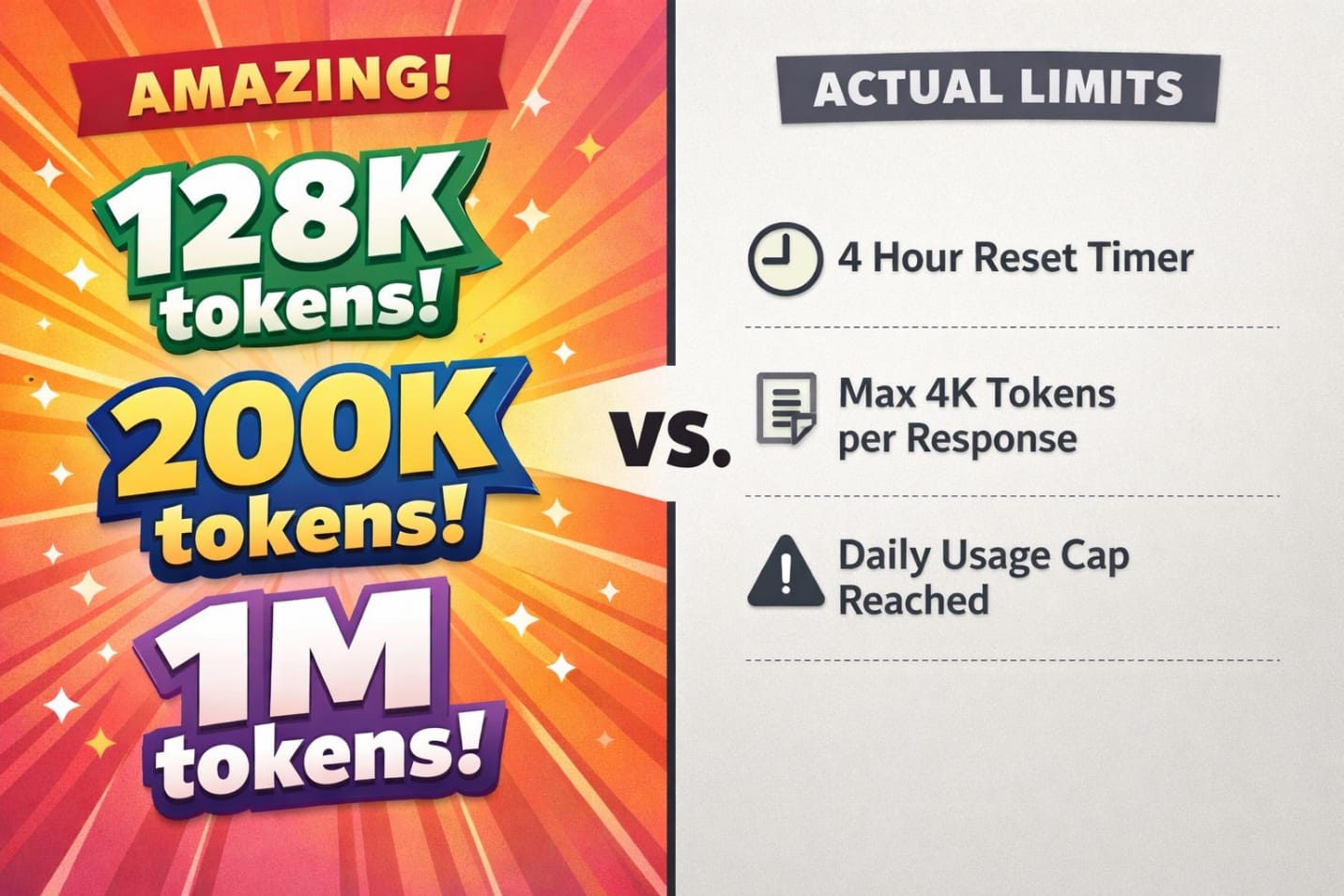 Caption: The real numbers: context window vs. reset schedule tells the actual story.
AI Token Limits Across ChatGPT, Claude, and Gemini: The Real Numbers
ChatGPT Plus ($20/month)
Context window: 128K tokens. Output limit: ~4,096 tokens per response. Reset: 5-hour rolling window. The reality: you can process medium-length conversations and keep about 40–50 back-and-forth exchanges before hitting the context limit. More important: your message allowance resets on a moving clock. Use up your quota in two hours, you wait three more before it resets. This platform is built for consistent, sustainable daily use — not for intensive sprints.
Best for: general writing, brainstorming, editing, answering questions. The output limit of ~4K tokens keeps responses concise, which works well for most writing tasks. The rolling reset teaches you good habits: spread your usage across the day rather than burning through it all at once.
Claude Pro ($20/month)
Context window: 200K tokens. Output limit: ~8,000 tokens per response (varies by model). Reset: 5-hour rolling window. The reality: 200K means you can build much longer conversations and include entire documents without worrying about context ceiling. The doubled output limit is significant — you can ask Claude for longer-form work in single responses. The rolling window is identical to ChatGPT, so the reset behavior is the same.
Best for: long-form content (essays, guides, detailed analysis), document analysis (contracts, reports), sustained project work where conversation history matters. The Projects feature (you create persistent workspaces with saved context) makes Claude uniquely good for workflows where you build on previous work repeatedly.
Claude Pro isn’t just ‘ChatGPT but more.’ The 200K context window and Projects feature fundamentally change how you can structure complex, multi-step work.
Gemini Advanced ($20/month)
Context window: 1M tokens — five times Claude’s and nearly ten times ChatGPT’s. Output limit: varies by model used (typically 8K–20K). Reset: daily, not rolling. The reality: the massive context window is genuinely useful if you work with huge documents, codebases, or research repositories. But the daily reset is a completely different constraint model than the other two. Burn through your quota at any time, you’re done until tomorrow. No 5-hour reset.
Best for: document analysis at scale (full books, research papers, entire codebases), research-heavy work, tasks that benefit from processing enormous amounts of context in one conversation. Less ideal for daily workflow pacing because the daily reset makes it harder to build sustainable usage habits.
The takeaway: context window is one constraint. Reset schedule is a separate one. Together they determine which platform fits your actual work rhythm.
Platform Comparison: The Numbers That Matter
Platform | Context Window | Usage Reset | Output Limit/Msg | Best For |
|---|---|---|---|---|
ChatGPT Plus | 128K tokens | 5-hour rolling | ~4,096 tokens | General writing |
Claude Pro | 200K tokens | 5-hour rolling | ~8,000 tokens | Long-form content |
Gemini Advanced | 1M tokens | Daily reset | Model-dependent | Document analysis |
Table: Core differences across three $20/month plans — note reset mechanics more than context window size.
The Marketing Trap: Confusing ‘More Tokens’ With ‘More Freedom’
Gemini Advanced’s 1-million-token context window sounds incredible next to Claude’s 200K. And technically it is. But here’s what the marketing doesn’t say: having a huge context window doesn’t mean you have unlimited freedom. You still have a usage cap. You still reset on a schedule. And some people find that a daily reset is actually more restrictive than a 5-hour rolling window if you work in multiple sessions.
The real advantage of Gemini’s massive window is specific: you can process entire large documents, research papers, or codebases in a single conversation without worrying that you’ll exceed the context limit. For document-heavy work, this matters. For everyday writing — blogs, emails, brainstorms, quick edits — the 128K window on ChatGPT Plus is plenty, and the 200K on Claude Pro is more than enough.
The biggest context window isn’t always the best deal. The right fit is the platform whose reset schedule and output limits match your actual workflow.
Paying $20/month for Gemini because it has a million-token window, then using it for writing blog posts, is like buying a semi truck because it has a bigger engine than a pickup, then mainly using it to run to the grocery store. You’re paying for capacity you don’t need.
The takeaway: bigger context window is genuinely useful for specific work. For general writing and content creation, it’s marketing noise.
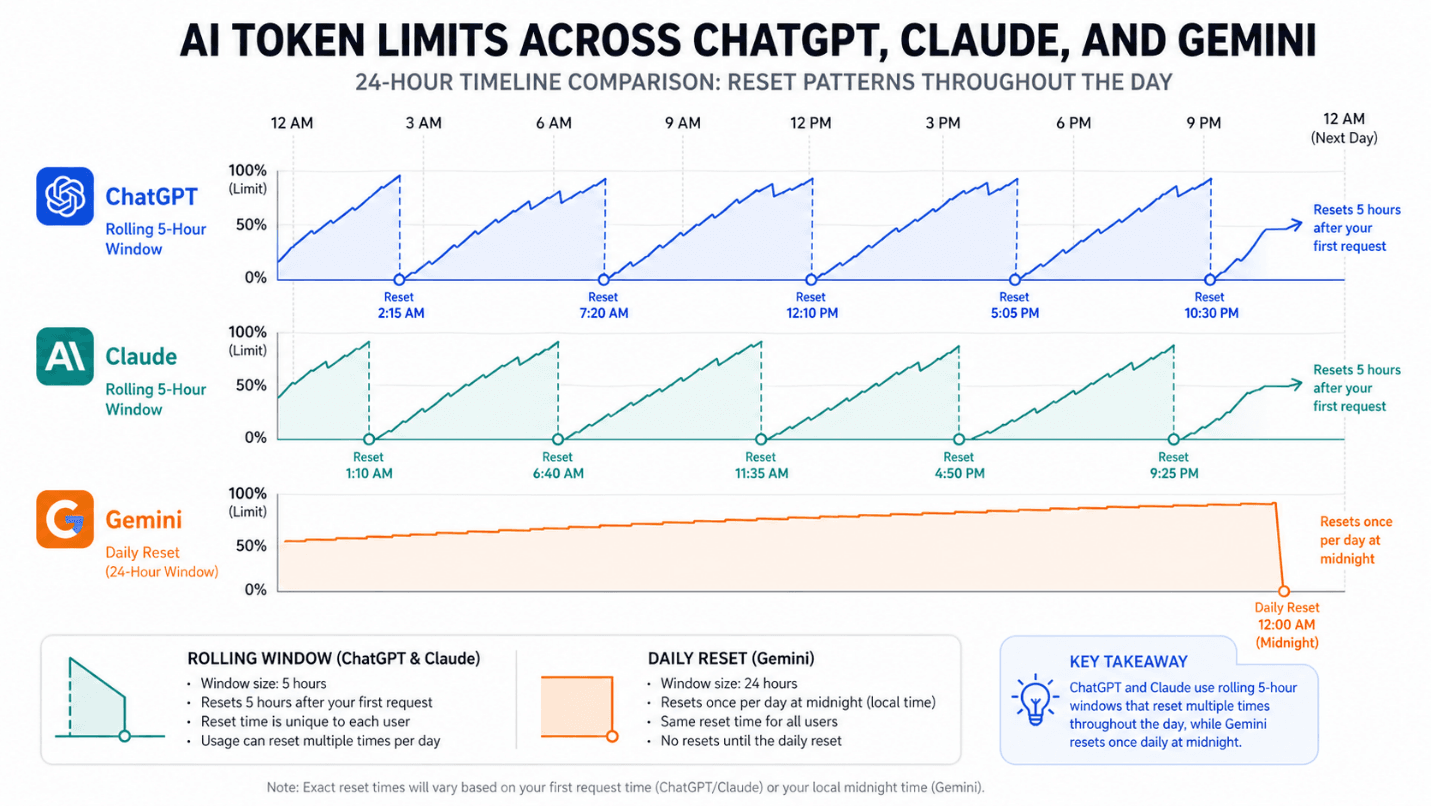 Caption: How different reset mechanics change your usage patterns throughout the day.
Choosing the Right Platform for Your Workflow
Does ChatGPT’s smaller context window mean I can’t write long content?
No, but the workflow is different. You break long projects into multiple conversations or use the summarize-and-continue trick from Post 2. It’s slightly more friction than Claude Pro’s 200K window, but entirely workable. The real advantage of bigger context isn’t that you can write longer — it’s that you can reference more source material without losing it.
Why does Claude Pro have a lower daily message limit than I’d expect with 200K context?
Because context window (memory capacity) and message limit (usage rate) are independent. Claude Pro’s rolling 5-hour window is the constraint that matters daily, not the context size. The window resets on a clock, not a message count.
Is Gemini Advanced worth it if I mainly write blog posts?
Probably not. The 1M token window is overkill for blog writing, and the daily reset is less convenient for multi-session workflows. Claude Pro’s 200K window and rolling 5-hour reset align better with sustainable daily writing habits. Save Gemini for research-heavy or code-heavy projects.
Can I use multiple platforms to avoid hitting limits?
Yes — and this is smarter than you might think. Using ChatGPT Plus for quick tasks, Claude Pro for long-form work, and Gemini Advanced for document analysis gives you three complementary workflows instead of three competing ones. Match each platform to its actual strength.
Choose the Platform That Fits How You Actually Work
None of these three platforms are universally ‘better’ than the others. They’re differently shaped tools. ChatGPT Plus is the generalist. Claude Pro is the long-form specialist with Projects. Gemini Advanced is the research powerhouse. Your choice should depend not on marketing numbers but on how you actually work.
The right AI platform isn’t the one with the biggest numbers. It’s the one whose constraints match your actual workflow and reset schedule.
Here’s the practical framework: if you write blog posts, emails, or general content, start with Claude Pro or ChatGPT Plus. The token optimization tricks from Post 2 matter more than context size. If you regularly process large documents or codebases, Gemini Advanced’s 1M window is worth the daily reset trade-off. If you’re still deciding, Claude Pro’s Projects feature (persistent context you set once) is the strongest competitive advantage any of the three platforms has — leverage it.
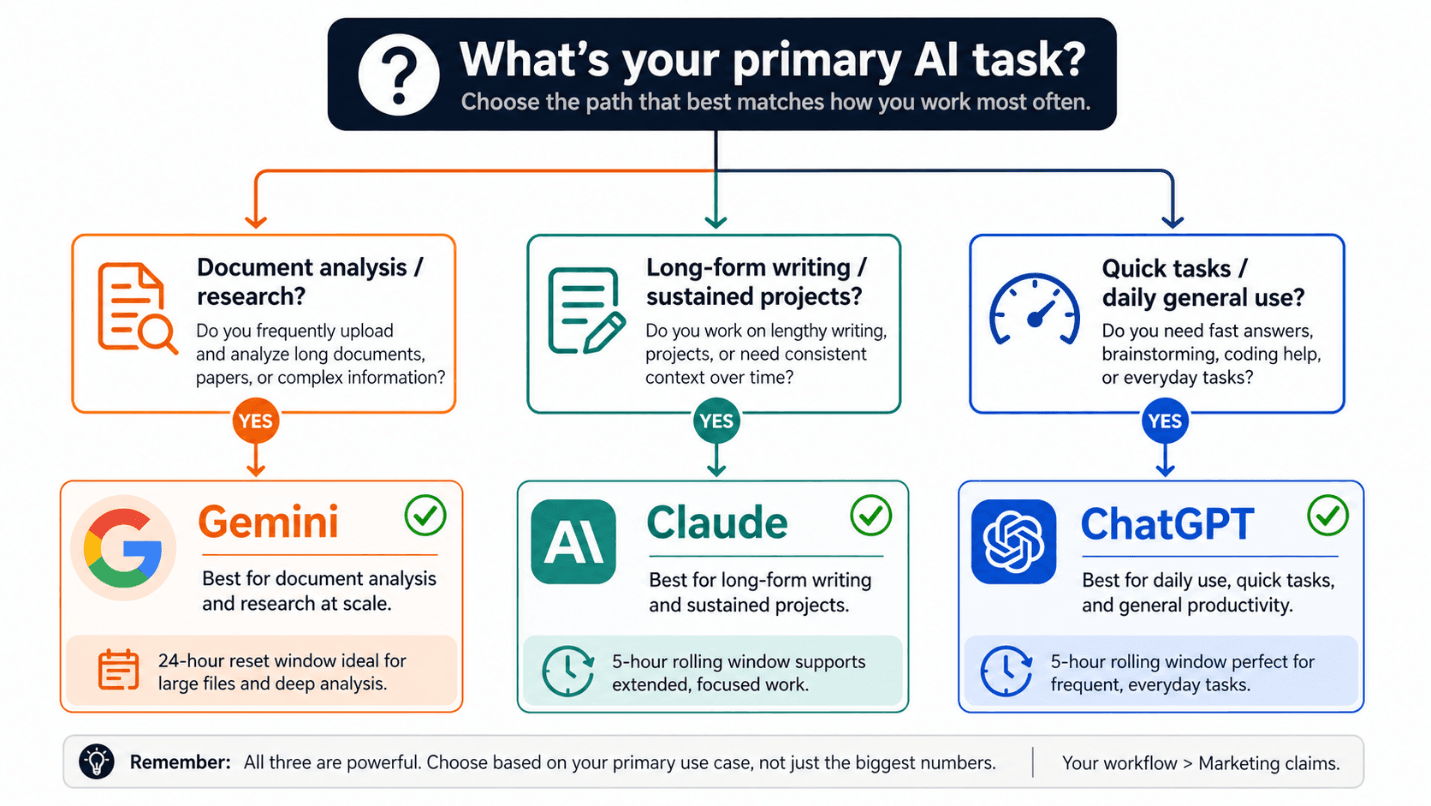 Caption: Simple decision framework: match platform to your primary workflow.
Now you have the full picture: how tokens work, how to optimize your prompts, and which platform actually fits your constraints. Go back to Post 1 if you missed it — start there.
What Nobody Tells Beginners About AI Token Limits — link to Post 1
You Now Know More Than Most AI Users
Most people using AI have no idea what tokens actually cost, what their real constraints are, or why they keep hitting limits. You do. Go back to the first post if you haven’t read it — the full three-post series gives you the complete framework. From understanding tokens to optimizing prompts to choosing the right platform, you’re now equipped to extend your budget and get more from your AI subscription than almost everyone else using the same $20/month plan.
What Nobody Tells Beginners About AI Token Limits — link to Post 1