How to Write Answer-First Articles That AI Overviews Can Cite (Without Hacks)
Disclosure: MakeBlogAI may earn a commission from some links on this site; this article contains no paid or affiliate links. It was researched and drafted with AI tools and checked by a person against the primary sources linked below. General information only — not legal, tax, or financial advice, and no income is promised or implied.
The short answer: Nobody can guarantee a citation in a Google AI Overview, and Google doesn’t publish a formula. What you can do is answer the question directly in the first paragraph, back it with dated facts and primary sources, use clear question-shaped headings, and include something a summary can’t replace, such as a table, tool or checklist. Pew found AI summaries appeared on 60% of searches that start with a question word, with a median length of just 67 words.
When Google shows an AI summary
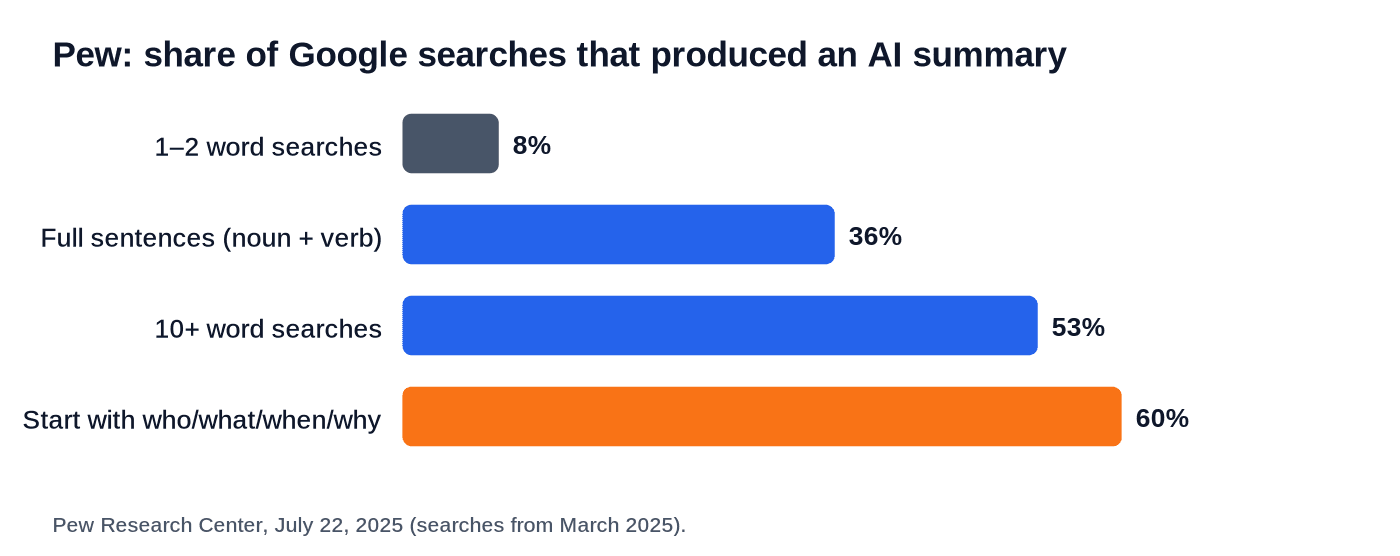
Pew Research Center’s analysis of real browsing data found that how a query is worded strongly affects whether a summary appears:
- Only 8% of one- or two-word searches produced one.
- 53% of searches with 10 or more words did.
- 60% of searches starting with “who,” “what,” “when” or “why” did.
- 36% of searches written as full sentences did.
So if your article targets a question, assume an AI summary will often sit above it. Your page has to earn its place, either as a source the summary cites or as the obvious next click for a reader who wants more.
What those summaries look like
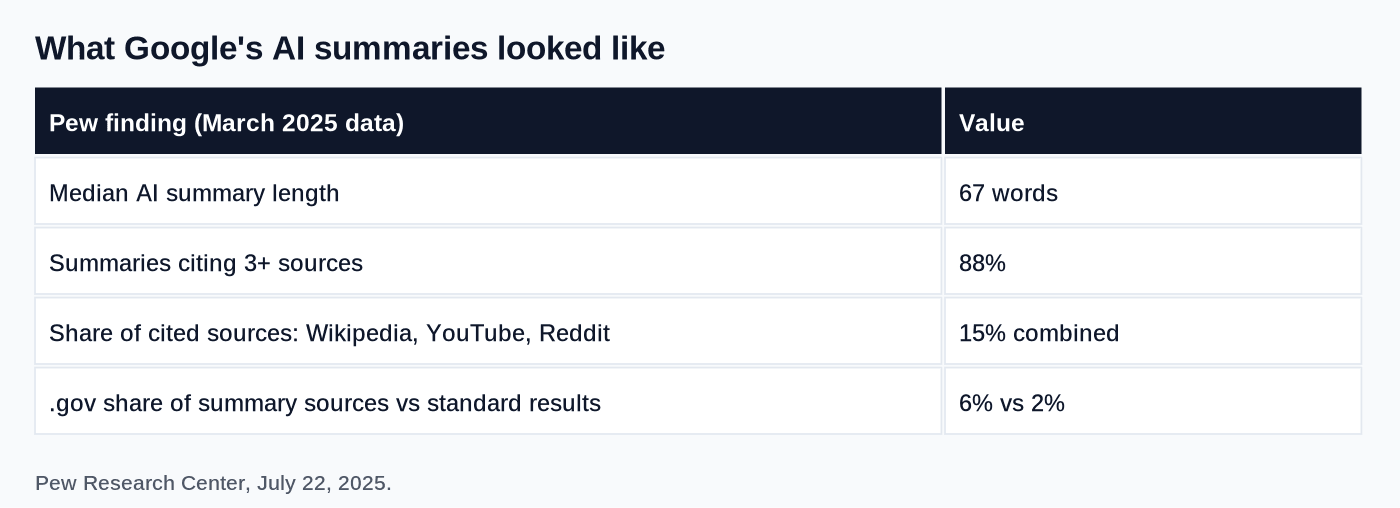
The typical summary was short (a median of 67 words) and usually cited several sources (88% cited three or more). Wikipedia, YouTube and Reddit together made up 15% of cited sources, and government sites appeared more often in summaries than in regular results. Short, multi-source answers favor pages that state facts clearly, near the top, with credible support.
The answer-first template
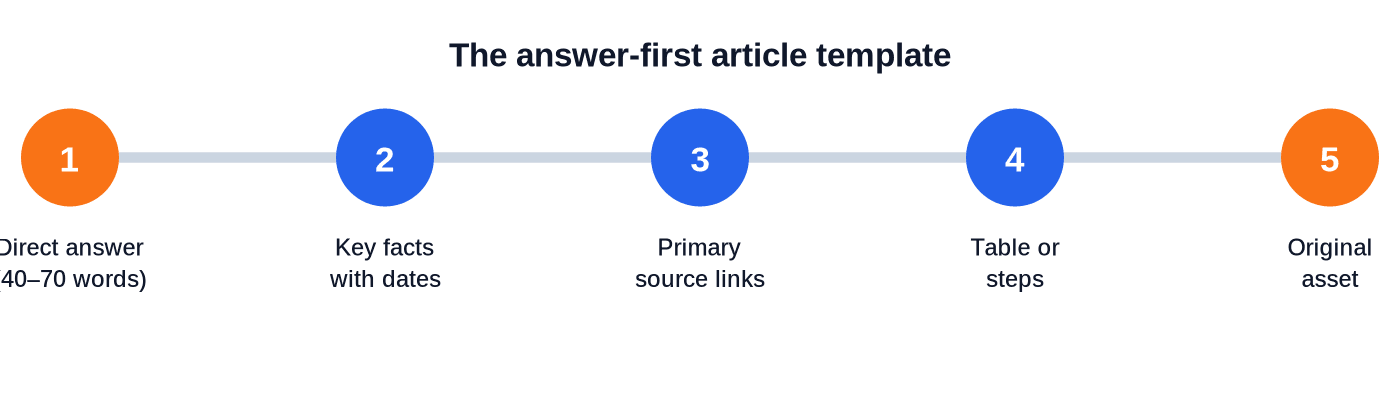
This is the structure every MakeBlogAI article follows:
- A direct answer box (about 40–70 words). Answer the exact question, include the key numbers or rules, and add a qualifier where honesty needs one.
- Key facts with dates. “As of October 14, 2026” is better than “currently.”
- Primary sources linked inline, right next to the claim they support, not dumped in a list at the end.
- A table or numbered steps for anything comparative or procedural.
- An original asset: a calculation, chart, checklist or tool. This is your reason to exist beyond the summary.
A worked example
Our fee comparison opens with what you keep on each platform from a $9.99 sale, then shows the calculation for each one, linked to each platform’s fee page. A summary can repeat the headline numbers, but readers who want to check the math or change the price still need the page.
Headings that match how people ask
Write H2s the way readers phrase questions: “Can you copyright an AI-assisted ebook?” rather than “Copyright Considerations.” Check the “People also ask” box and the competing titles for your topic to see the real wording, then answer each question in the first sentence under its heading.
What not to do
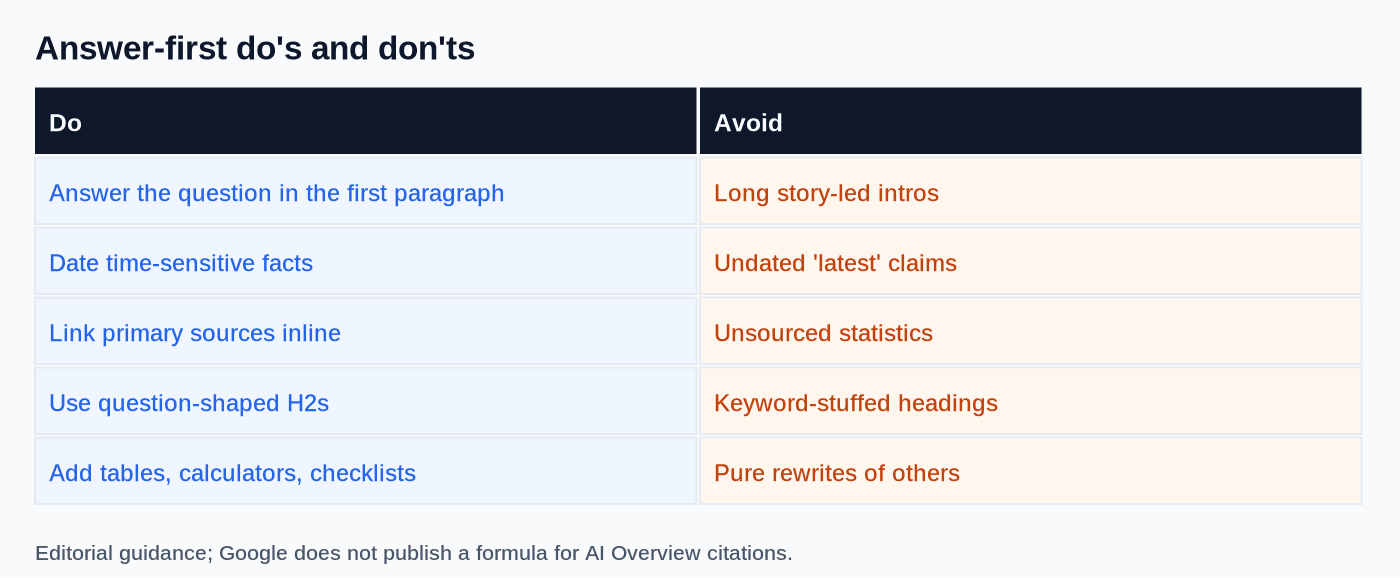
- Don’t chase “AI Overview hacks.” Anything that claims a guaranteed citation is selling something.
- Don’t invent data. Unsourced statistics hurt trust, and summaries citing several sources can expose them.
- Don’t bury the answer under a personal story.
- Don’t stuff keywords. Clear language works better than repetition.
Measure, don’t assume
In Google Search Console, watch impressions and clicks for the queries you target. Pew’s data and later industry reports describe the same pattern: impressions hold steady while clicks fall. Judge your own pages by your own numbers, not by studies of other sites.
Before and after: rewriting an intro
Before (story-first): “When I first started looking into ebook pricing, I was overwhelmed. There are so many options, and everyone has an opinion…”
After (answer-first): “On Amazon.com, an ebook priced $2.99–$12.99 can use KDP’s 70% royalty, which is 70% × (price − $0.15 per MB delivery). A 1 MB book at $4.99 earns about $3.39 per US sale, compared with $1.75 at 35%.”
The second version gives a summary something accurate to cite and gives the reader a reason to keep going: the calculator and file-size table on our pricing page.
An answer-box checklist
- Does it answer the exact question in the first sentence?
- Does it include the key number, rule or date?
- Is it under about 70 words? (Pew’s median AI summary was 67 words.)
- Is every fact in it linked to a source further down?
- Does it include an honest qualifier where one is needed (“as of,” “in the US,” “reported”)?
Step by step: building an answer-first post
- Collect real question phrasing from Google’s “People also ask,” related searches and competing titles.
- Pick the main question and two to five related ones.
- Research primary sources first, and record the date you checked each one.
- Write the answer box, then an H2 for each related question.
- Add one original asset (a table, chart, calculator or checklist).
- Add a short FAQ using the real phrasing from step 1.
- Review after 60–90 days in Search Console and update dated facts.
Common mistakes
- Answer boxes that just repeat the title.
- FAQ questions nobody actually asks.
- Updating the “last updated” date without changing the content.
- Copying competitors’ structure and adding nothing new.
FAQ
How do I get my site cited in Google AI Overviews?
There’s no guaranteed method, and Google doesn’t publish one. Clear direct answers, credible sourcing and original content give you the best chance.
How long should an answer paragraph be?
Short. In Pew’s data the median AI summary was 67 words, so an answer of about 40–70 words that a summary could quote accurately is a reasonable target.
Do FAQ sections help with AI search?
They help readers when they use real question wording and give direct answers. Treat any ranking benefit as uncertain.
The bottom line
Answer-first writing is just good writing: say the answer, prove it, then give readers something more. It won’t guarantee citations, but it gives your page a better chance.
Series: Blogging That Still Works in the AI-Search Era. Pillar: Is blogging still worth it? · Answer-first articles (you are here) · Next: FTC affiliate disclosures