TPT’s New AI Stance: What Sellers Know So Far (and What to Do Now)
Disclosure: MakeBlogAI may earn a commission from some links on this site; this article contains no paid or affiliate links. It was researched and drafted with AI tools and checked by a person against the primary sources linked below. General information only — not legal, tax, or financial advice, and no income is promised or implied.
The short answer: At its October 8, 2026 seller town hall, TPT said it wants a marketplace that is “teacher-created, classroom ready, and AI free.” Sellers were told not to use generative AI for the text or images in resource files, covers, thumbnails, previews or product descriptions, and to start replacing AI content they’ve already published. As of October 14, TPT hasn’t published a written AI policy. Start a calm review of your store now, beginning with covers, and wait for the written rules before you delete anything.
What TPT actually announced
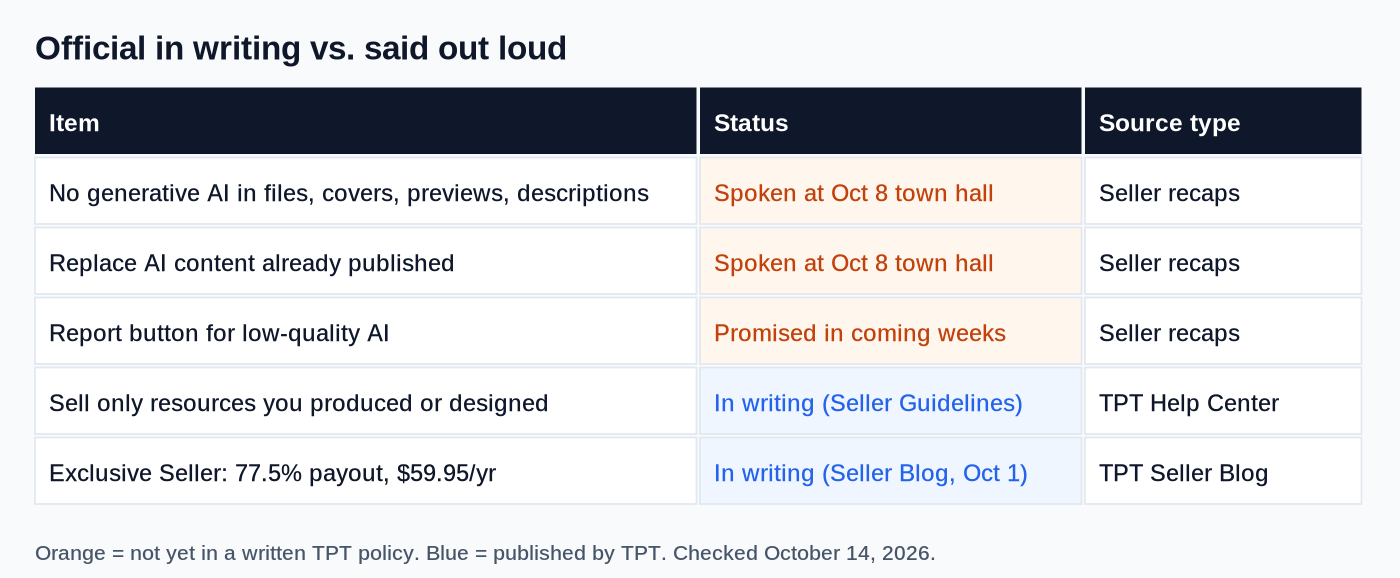
Everything in this section comes from seller recaps of the town hall, not from a TPT document. Two detailed write-ups agree on the main points: More Lessons Less Planning (posted October 8) and Graphene (status note dated October 10).
- Going forward: no generative AI for the images or text in resources or listings. The list given was resource files, cover images, thumbnails, preview files and product descriptions.
- Already published: sellers were asked to replace AI-generated content with their own work. Covers and thumbnails were named as the place to start.
- Reporting: buyers and sellers will be able to report low-quality AI resources “in the coming weeks.” TPT asked sellers not to start hunting through other stores yet.
- Enforcement focus: TPT said it would go after the lowest-quality products first.
Before the town hall, IXL Learning’s CEO had already told reporters that TPT uses “algorithmic tools to identify and demote stores associated with low-quality, AI-generated content.” That quote was reported by The Course Times, and we haven’t seen the original statement ourselves. Note that it refers to stores, not individual products.
What’s in writing, and what isn’t yet
This is the distinction that matters most right now. TPT’s Seller Guidelines already say: “You should only sell resources that you’ve produced or designed yourself,” and sellers must make sure titles and descriptions are “truthful, accurate and free of mistakes.” Those lines are in writing today.
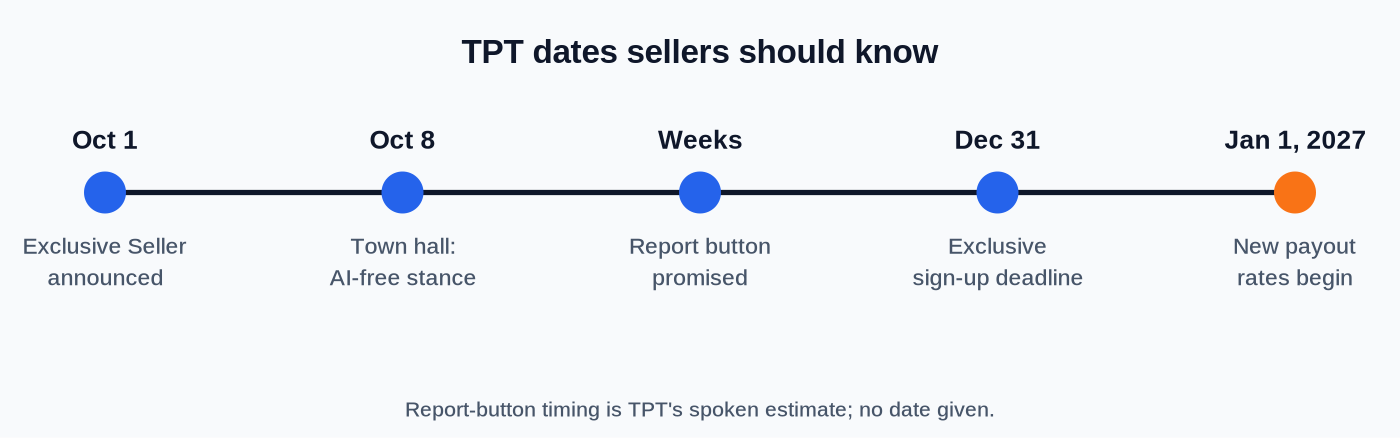
The broader “no generative AI anywhere” instruction isn’t yet. The recaps say TPT will send the written version by email, post it on the Seller Blog and cover it in another webinar. When we checked the TPT Seller Blog on October 14, the newest post was still the October 1 Exclusive Seller announcement.
Open questions to bring to the written policy
- Does “AI” include spell-check, grammar tools or AI cleanup inside design apps?
- Is there a deadline for updating existing products?
- Will clip art licensed from third parties be treated differently if the artist used AI?
- How will appeals work if a product is reported by mistake?
We don’t know the answers to any of these yet, and you shouldn’t trust anyone who claims to.
The other big change: Exclusive Seller
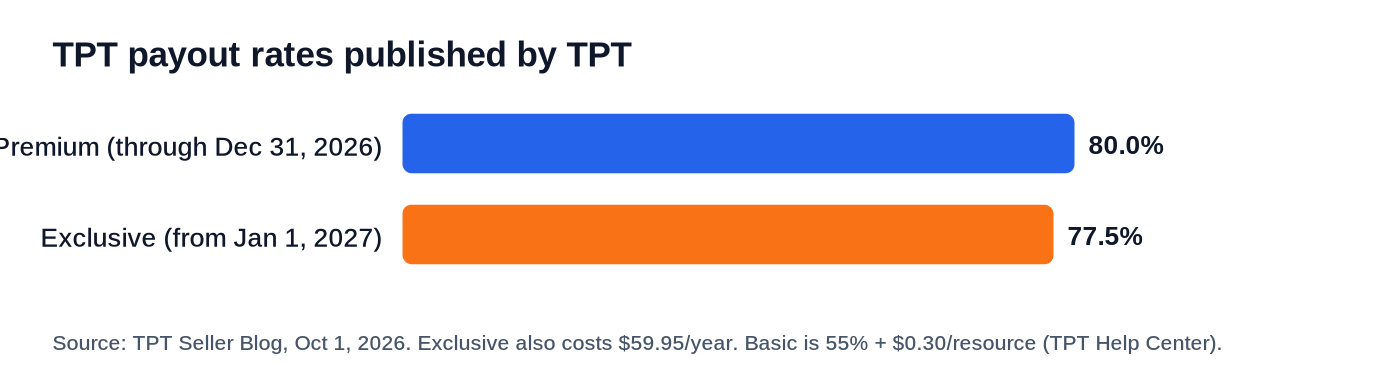
Separately from AI, TPT announced on October 1 that it will replace the Premium Seller membership with an Exclusive Seller membership starting January 1, 2027 (TPT Seller Blog). Here’s what TPT published:
| Item | Premium (now) | Exclusive (from Jan 1, 2027) |
|---|---|---|
| Payout rate | 80% through December 31, 2026 | 77.5% |
| Annual fee | Not restated in the announcement | $59.95 |
| Transaction fee | None on orders over $3; $0.15 per resource on orders under $3 (unchanged) | |
| Exclusivity | None | TPT-eligible resources must be sold only through TPT |
| Sign-up deadline | — | December 31, 11:59 p.m. ET, to start on January 1 |
Exclusivity has limits. TPT says you can still promote your resources elsewhere and keep your own website, but “the final purchase must be processed through your TPT store.” If you sell the same resources on Etsy, Gumroad or your own site, that’s a real tradeoff.
Our fee comparison shows what each platform keeps per sale. If you leave Exclusive after January 1, TPT says there’s a one-year wait before you can rejoin.
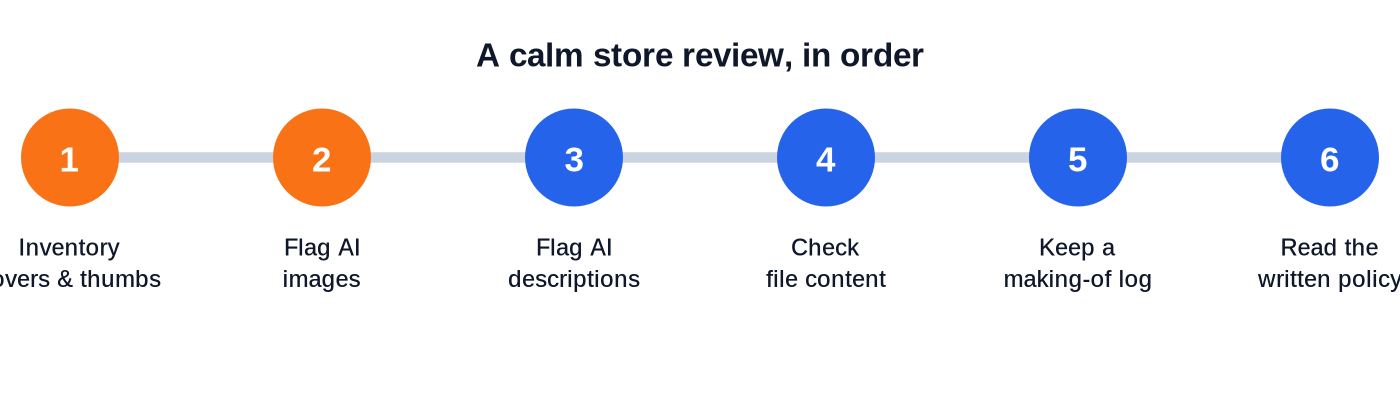
A calm review of your store, in order
- Inventory your covers and thumbnails. TPT named these first, and buyers see them first. Mark any you made with an image generator.
- Plan replacements for flagged covers. Use your own design, a photo of the resource in use, or clip art you’ve licensed for commercial use.
- Review product descriptions. If a chatbot drafted one, rewrite it yourself. Say what the resource is, who it’s for, and how long it takes.
- Check inside the files. Note any pages where AI produced text or images.
- Keep a simple “how I made this” log for each product: dates, the tools you used, and which parts are your own. It helps if a product is ever reported.
- Read the written policy when it arrives, save a copy, and compare it with your list before you rewrite anything else.
What this means beyond TPT
TPT’s position is stricter than most marketplaces. Amazon KDP allows AI-generated content if you disclose it (our KDP guide). Etsy allows “seller-prompted AI creations” with disclosure (our Etsy guide).
If you sell on more than one platform, the strictest rule for a given product decides how you make it. Our disclosure comparison puts all of them side by side.
Basic, Premium or Exclusive: the numbers TPT publishes
TPT’s Seller Fees and Payout Rates page, which TPT says is part of its Terms of Service, compares the two memberships that continue after January 1:
| Basic Seller | Exclusive Seller | |
|---|---|---|
| Membership fee | One-time, non-refundable $29 | $59.95/year |
| Payout rate | 55% on all sales | 77.5% on all sales |
| Transaction fee | $0.30 per resource | $0.15 per resource, only on orders under $3 |
| Premium tools & marketing | No | Yes |
| Exclusivity | No | Digital educational resources sold only on TPT |
TPT’s FAQ for new and Basic sellers adds that Basic and new sellers who sign up as Exclusive between October 1 and December 31, 2026 get an introductory 80% payout rate until January 1, 2027. It also says “there are no changes to the Basic Seller membership.”
Worked example: one $5.00 resource
| Membership | Calculation | You keep |
|---|---|---|
| Basic | 5.00 × 0.55 − 0.30 | $2.45 |
| Exclusive (2027) | 5.00 × 0.775 (no fee on orders over $3) | $3.88 |
At those per-sale numbers, Exclusive’s $59.95 annual fee is covered after about 42 sales of a $5 resource a year (59.95 ÷ $1.42 difference per sale), before counting what you’d give up by selling only on TPT. This is fee arithmetic, not a recommendation. If most of your income comes from Etsy or your own site, the exclusivity matters more than the rate.
Common mistakes to avoid right now
- Deleting products in a panic. TPT hasn’t published the written rules. Make backups and plan replacements, but don’t remove reviewed, selling products before you know what the policy actually says.
- Taking a summary as the policy. Recaps, including this one, aren’t TPT’s words. Save the official email or blog post when it arrives.
- Forgetting the December 31 deadline. To start as Exclusive on January 1, TPT says you must sign up by December 31 at 11:59 p.m. ET.
- Assuming Exclusive bans your website. TPT says you can keep your website and promote elsewhere. The purchase itself has to happen in your TPT store.
- Not backing up. Keep your own copy of every product file and cover, separate from TPT.
Seller checklist for this quarter
- Back up every product file, cover and description.
- Make a list of AI-made covers and thumbnails, and plan replacements.
- Rewrite any AI-drafted descriptions in your own words.
- Decide Basic or Exclusive by December 31, using your own sales mix.
- If you choose Exclusive, change “Buy Now” links elsewhere to point to your TPT listings.
- Read and save the written AI policy when it’s published.
FAQ
Does TPT allow AI-generated resources?
As of October 14, 2026, TPT has said out loud, at its October 8 town hall, that sellers shouldn’t use generative AI in resources or listings. A written policy hasn’t been published yet. TPT’s existing guidelines already require resources “you’ve produced or designed yourself.”
Will TPT remove my store for AI covers?
We don’t know. TPT has said it is targeting the lowest-quality products first.
IXL’s CEO was reported as saying stores linked to low-quality AI content are demoted. Replacing AI covers early is the cautious choice.
What is the TPT Basic seller payout rate?
55% on all sales, plus a $0.30 transaction fee per resource and a one-time $29 membership fee, according to TPT’s Seller Fees and Payout Rates page.
Can I sell on Etsy and TPT at the same time?
As a Basic seller, yes. As an Exclusive seller, TPT says your TPT-eligible digital educational resources must be bought through TPT, though you can still promote them elsewhere.
The bottom line
Don’t panic, and don’t wait either. Start with covers and descriptions, keep records, and treat everything here as “what we know so far.” We’ll update this page when TPT publishes its written policy.
Series: Selling Digital Products With AI Help. Pillar: Gumroad vs KDP vs Etsy fees · Etsy AI downloads · TPT AI stance (you are here) · Disclosure rules compared