Can You Copyright an AI-Assisted Ebook or Printable? The Copyright Office’s Position, Explained
Disclosure: MakeBlogAI may earn a commission from some links on this site; this article contains no paid or affiliate links. It was researched and drafted with AI tools and checked by a person against the primary sources linked below. General information only — not legal, tax, or financial advice, and no income is promised or implied.
The short answer: Partly. The U.S. Copyright Office concluded in January 2025 that copyright “does not extend to purely AI-generated material,” and that with current tools “prompts do not alone provide sufficient control.” But using AI “to assist rather than stand in for human creativity” doesn’t take away protection. Your own writing, your meaningful changes, and your creative selection and arrangement can be protected.
Raw AI output can’t. This is general information, not legal advice.
The Copyright Office’s conclusions
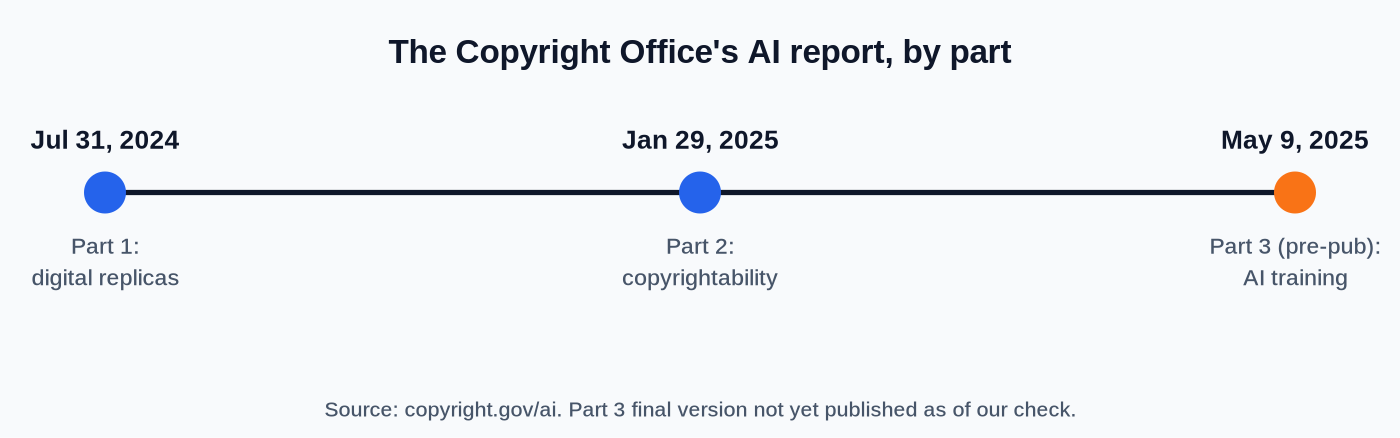
Part 2 of the Office’s Copyright and Artificial Intelligence report (published January 29, 2025) covers whether AI outputs can be copyrighted. Its conclusions include:
- “The use of AI tools to assist rather than stand in for human creativity does not affect the availability of copyright protection for the output.”
- “Copyright does not extend to purely AI-generated material, or material where there is insufficient human control over the expressive elements.”
- “Whether human contributions to AI-generated outputs are sufficient to constitute authorship must be analyzed on a case-by-case basis.”
- “Based on the functioning of current generally available technology, prompts do not alone provide sufficient control.”
- Human authors are entitled to copyright in “their works of authorship that are perceptible in AI-generated outputs, as well as the creative selection, coordination, or arrangement of material in the outputs, or creative modifications of the outputs.”
The Office also concluded that existing law can handle these questions without new legislation.
What this means for an ebook
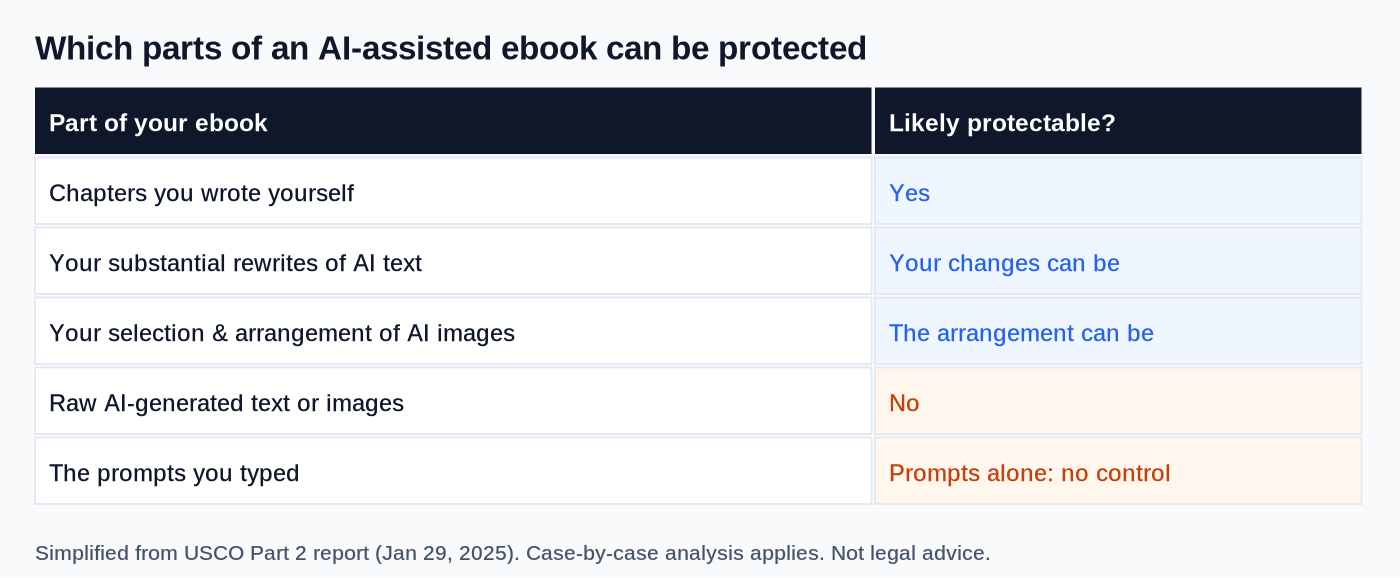
Text you wrote
Chapters you wrote yourself are protected as usual, even if you used AI to brainstorm or fix grammar. On Amazon this also counts as “AI-assisted,” which KDP doesn’t require you to disclose (see our KDP guide).
Text an AI drafted
Raw AI-generated passages aren’t protected. If you substantially rewrite them, your creative changes can be. How much rewriting is enough is the “case-by-case” question, and nobody can give you a formula.
Note too that KDP still counts AI-drafted text as “AI-generated” for disclosure, “even if you applied substantial edits afterwards.” Copyright and platform rules use different tests.
AI images and covers
An AI-generated cover image by itself isn’t protected. Your layout, typography and arrangement of elements may be. For a printable or workbook, your selection and arrangement of AI images into a designed product can be protected, but the individual images may not be.
Why prompts aren’t enough
The Office’s reasoning is that with today’s tools, the same prompt can produce many different outputs, and the person typing it doesn’t control the expressive details. Detailed prompts still don’t make you the author of the result, according to the report. Commenters it quotes describe simple prompts as unprotectable “ideas or instructions.”
What this means in practice
| Risk | What it means for you |
|---|---|
| Copying of purely AI content | Someone may be able to reuse raw AI images or text from your product without infringing your copyright |
| Weak registration | If you register a work, the Office’s guidance asks applicants to identify AI-generated material (see its AI page for registration guidance) |
| Infringement by the AI output | Separately, you’re responsible if an output copies someone else’s protected work; KDP’s guidelines say so too |
Protecting the human part
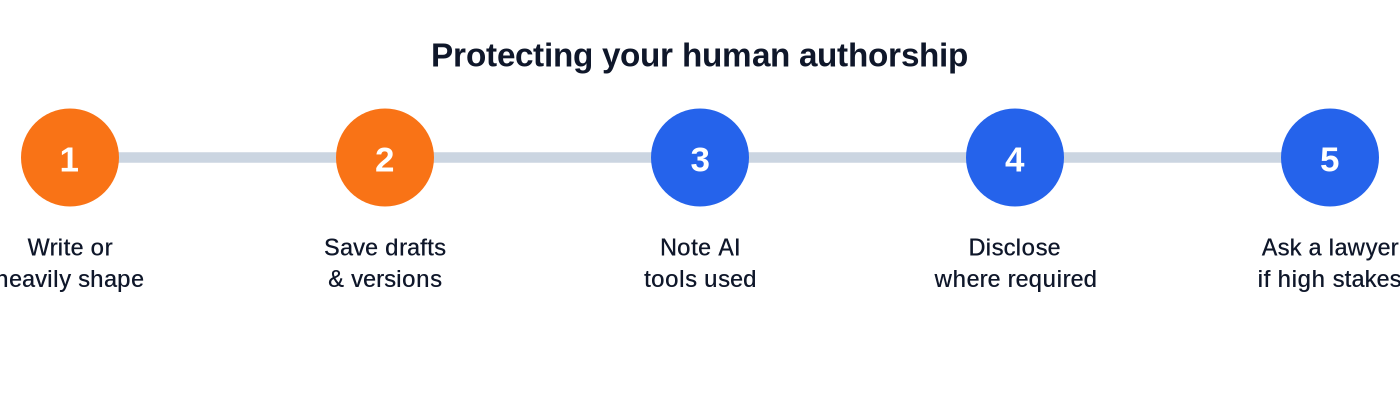
- Write the core yourself, or shape it heavily: structure, examples, voice.
- Keep drafts and version history that show your own contributions.
- Note which AI tools you used and what for.
- Disclose where platforms require it. That’s separate from copyright.
- Talk to an attorney before registering or enforcing anything that matters commercially.
Copyright isn’t the same as platform rules
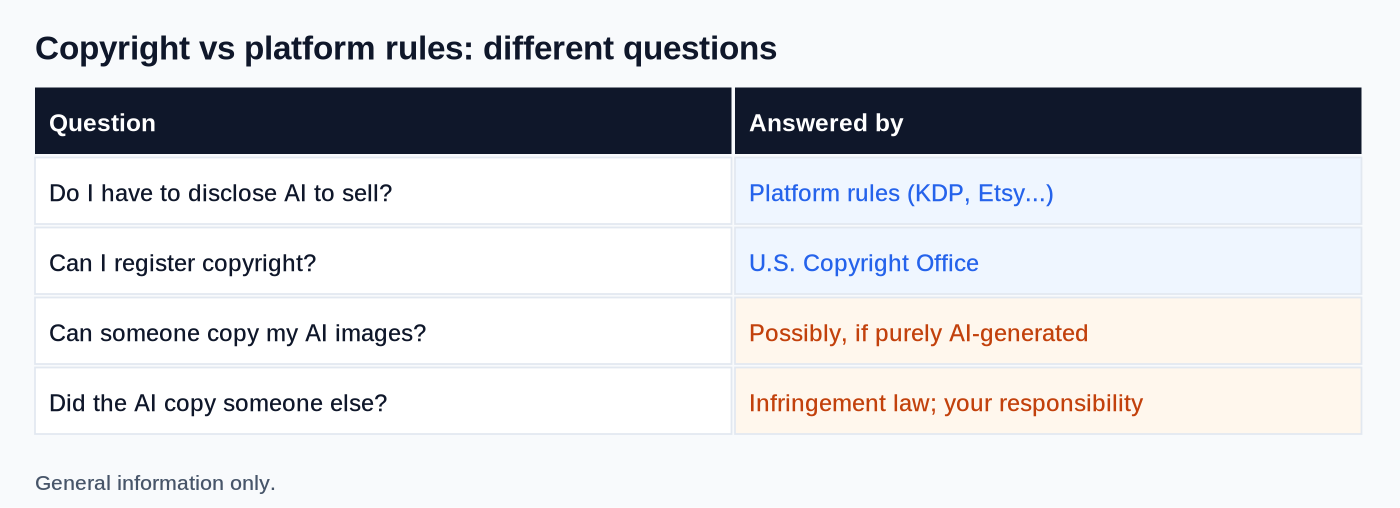
Amazon, Etsy and TPT set their own disclosure and content rules, and those apply whether or not your work is protected by copyright. Our disclosure comparison covers those.
How registration works with AI content
The Copyright Office’s registration guidance (effective March 16, 2023) says applicants “have a duty to disclose the inclusion of AI-generated content in a work submitted for registration and to provide a brief explanation of the human author’s contributions.” In practice:
- Use the Standard Application. The guidance says other forms don’t have fields for disclaiming AI material.
- In “Author Created,” describe your human authorship, for example “Selection, coordination, and arrangement of [human content] created by the author and [AI content] generated by artificial intelligence.”
- Exclude AI content that’s more than minor under “Limitation of the Claim” → “Material Excluded” → “Other,” for example “[description] generated by artificial intelligence.”
- Don’t list an AI tool or company as an author or co-author.
- If you’re unsure, the guidance says you can simply state that the work contains AI-generated material, and the Office will contact you.
The guidance also warns that failing to correct the record “risk[s] losing the benefits of the registration.” Corrections are made through a supplementary registration.
A real example the Office cites
In February 2023, the Office reviewed a graphic novel with human-written text and images generated by an AI service. It concluded the work as a whole was copyrightable, “but that the individual images themselves could not be protected by copyright.” That case maps closely onto illustrated AI-assisted ebooks and printables.
Worked scenarios
| Your ebook | Likely outcome under the guidance |
|---|---|
| You wrote all the text; AI fixed grammar | Your text is protected; ordinary tool use |
| You wrote the text; AI generated 10 illustrations | Text and arrangement can be protected; the individual images can’t |
| AI drafted every chapter from your outline; you lightly edited | Mostly AI-generated; little protectable expression |
| AI drafted; you rewrote heavily and restructured | Your modifications may be protectable, case by case |
Common mistakes
- Listing “ChatGPT” or another tool as co-author.
- Registering without disclosing AI-generated material.
- Assuming detailed prompts make you the author. The guidance compares prompts to “instructions to a commissioned artist.”
- Confusing KDP’s disclosure rules with copyright registration rules.
FAQ
Can AI-generated books be copyrighted?
Not the purely AI-generated parts. Human-authored text, creative selection and arrangement, and sufficient human modifications can be.
Do I have to tell the Copyright Office I used AI?
If you register, yes. The guidance says applicants must disclose AI-generated content that’s more than de minimis and describe the human contribution.
Are my prompts copyrighted?
The Office says some prompts may themselves be creative enough to be protected, but that doesn’t make the generated output copyrightable.
Can someone copy my AI-generated cover?
If the image is purely AI-generated, it may not be protected by copyright. Your layout and typography may be. Ask an attorney for specific situations.
The bottom line
The more of the book is genuinely yours, the more of it is protected. Treat raw AI output as material you can’t own, and put your effort into the writing, structure and design that make the product worth buying.
Series: Publish an AI-Assisted Ebook, the Right Way. Pillar: KDP 2026 guide · Copyright (you are here) · Next: Pricing your first ebook
Not legal advice. U.S. law only. Other countries treat AI authorship differently.