Is Blogging Still Worth It After AI Overviews? What the Click Studies Actually Show
Disclosure: MakeBlogAI may earn a commission from some links on this site; this article contains no paid or affiliate links. It was researched and drafted with AI tools and checked by a person against the primary sources linked below. General information only — not legal, tax, or financial advice, and no income is promised or implied.
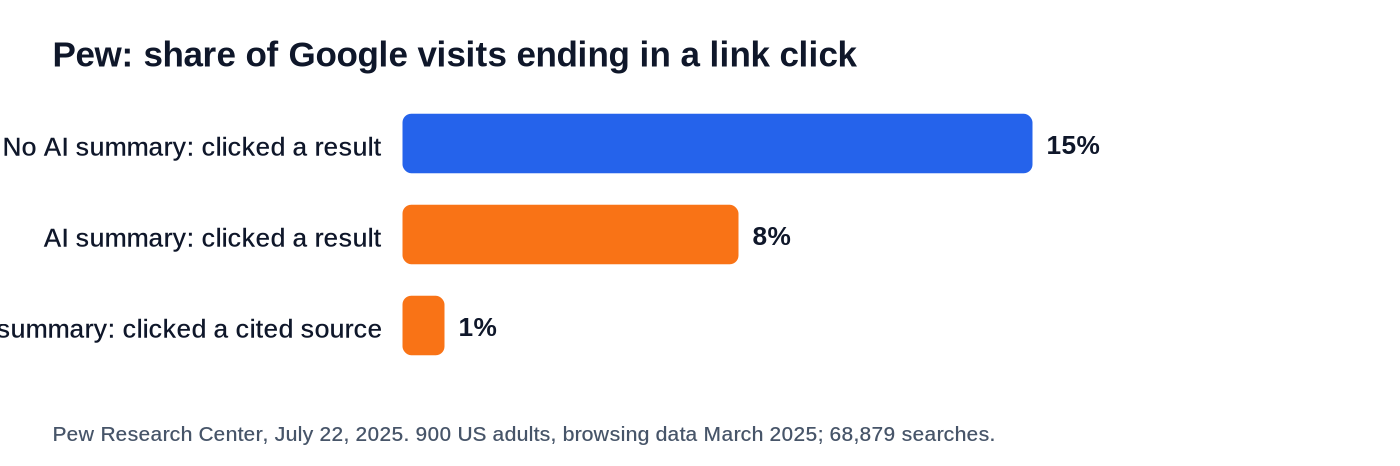
The short answer: Yes, but not the same kind of blogging as before. Pew Research found that people clicked a regular search result in 8% of visits when Google showed an AI summary, versus 15% when it didn’t, and clicked a source inside the summary only 1% of the time. Seer Interactive found organic click-through rates on affected informational queries fell from 1.76% to 0.61%.
Generic “what is” posts have lost the most. Original data, tools, real comparisons and an audience you own still hold up.
The study most worth trusting: Pew Research
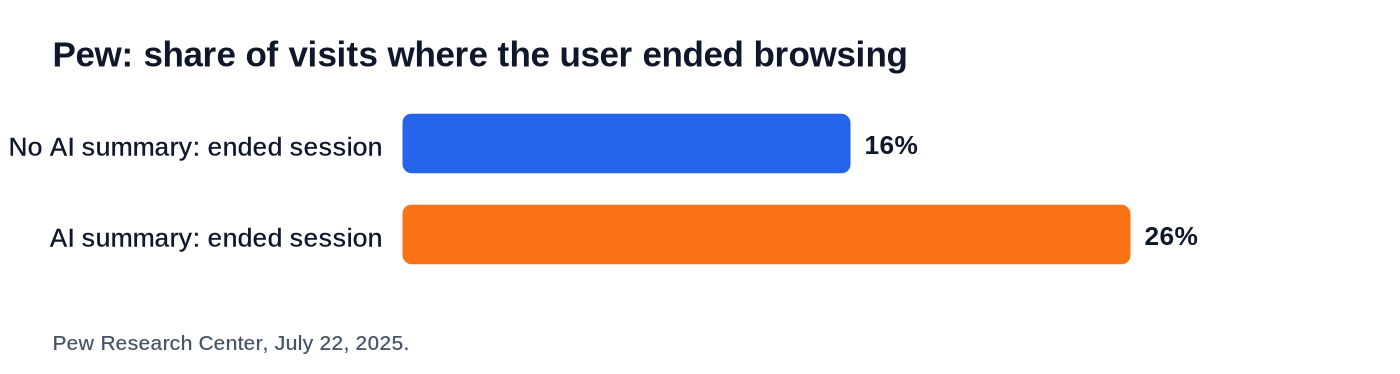
Pew’s July 2025 analysis is unusual because it measured real behavior, not estimates. 900 U.S. adults agreed to share their browsing during March 2025, and Pew analyzed 68,879 Google searches from that data. Key findings:
- People clicked a traditional result in 8% of visits to pages with an AI summary, and in 15% of visits to pages without one.
- They clicked a link inside the summary in just 1% of visits.
- They ended their browsing session on 26% of pages with a summary, versus 16% without.
- About 18% of searches produced an AI summary at that time. Questions and longer searches triggered them much more often.
One caveat: the data is from March 2025, and AI summaries have expanded since then. The share of searches that show one is probably higher today, but we don’t have an equally rigorous current figure.
The agency data: Seer Interactive
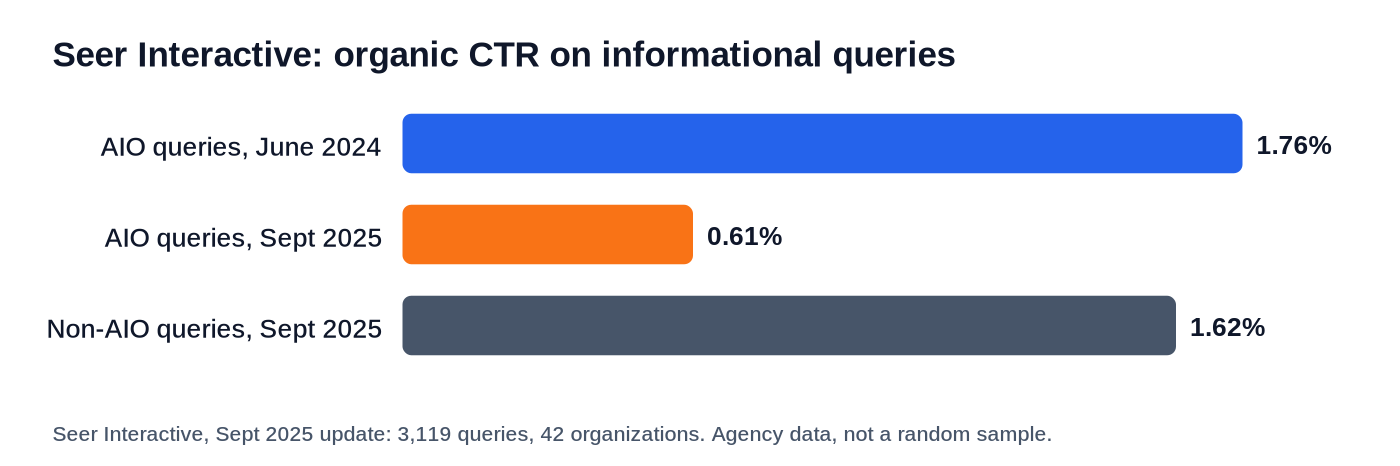
Seer Interactive’s September 2025 update looked at 3,119 informational queries across 42 client organizations. For queries that showed AI Overviews, organic CTR fell from 1.76% (June 2024) to 0.61%, a 61% drop.
Queries without AI Overviews also fell, to 1.62% (down 41% year over year). That second number matters: clicks are declining across the board, not only where AI summaries appear.
Seer’s data comes from its own clients, not a random sample, so treat it as a strong signal rather than a universal rule. Many 2026 articles quote even bigger numbers. Before you trust any of them, check where the data came from.
What this means for a new blog
What’s most exposed
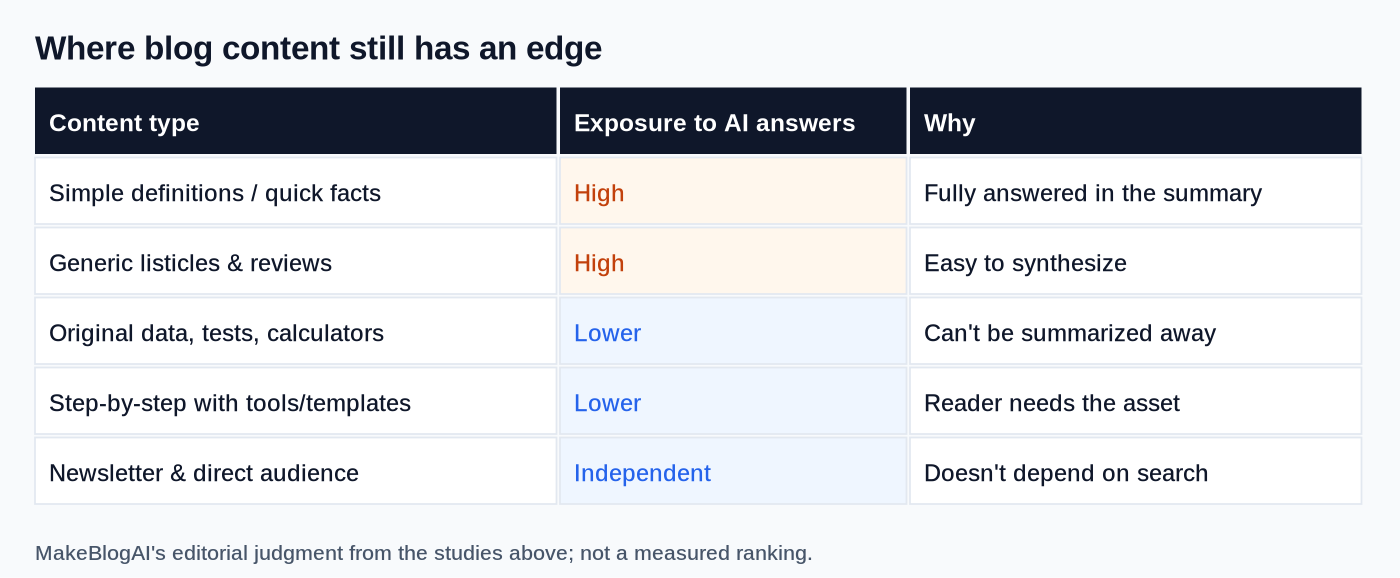
Quick definitions, simple how-tos and “best X” roundups built from other people’s reviews are exactly what an AI summary can answer without a click. Pew found summaries appeared on 60% of searches that started with question words like “what” or “why.” If your whole plan is ranking for questions like that, expect less traffic than older blogging advice promised.
What still earns visits
- Original data and worked examples. A fee table calculated from source pages, for example, like our platform fee comparison.
- Tools and templates. Readers have to visit to use them, like our ebook pricing calculator.
- Timely, verified updates. Policy changes summarized with dates and primary links.
- Being cited. Seer and others report that pages cited inside AI answers fare better than pages that only rank. Getting cited isn’t guaranteed. Our answer-first guide covers what you can control.
- An audience you own. Email subscribers don’t depend on Google at all.
Honest expectations
| Old assumption | 2026 reality (from the data) |
|---|---|
| Rank on page one and you’ll get clicks | Clicks per ranking are lower, especially on questions |
| More posts means more traffic | Thin posts are what AI summaries replace most easily |
| Search is the main channel | Search is one channel; email and community matter more now |
None of these studies say how much a particular blog will earn, and neither do we. They describe a clear shift in where clicks go.
How MakeBlogAI is responding
We’re applying this to ourselves. Every article starts with a direct answer, uses primary sources linked inline, and includes something you can’t get from a summary: a calculation, a comparison table, a checklist or a tool. We’ll report our own Search Console results once there’s enough data to mean something.
How to read these studies without being misled
| Study | Method | Strength | Limitation |
|---|---|---|---|
| Pew (July 2025) | Real browsing of 900 US adults, 68,879 searches | Measured behavior; independent | March 2025 data; Google only |
| Seer Interactive (September 2025) | 3,119 queries, 42 client organizations | Large impression counts, long time span | Agency’s own clients, not a random sample |
Pew also found that around two-thirds of all searches ended with the user browsing elsewhere on Google or leaving without clicking a result, whether or not a summary appeared. Low click rates aren’t new. AI summaries pushed them lower.
Worked example: what the click rates mean for a page
Using Seer’s averages as an illustration, not a forecast: a page earning 10,000 impressions a month on informational queries would get about 176 clicks at the June 2024 CTR (1.76%) and about 61 at the September 2025 CTR with AI Overviews (0.61%). Rankings can stay the same while traffic drops by more than half, which is why Search Console clicks, not rankings, are the number to watch.
A practical plan for a new blog
- Choose topics where you can add something: a calculation, comparison, template or verified policy summary.
- Answer first, then go deeper. See the answer-first template.
- Cite primary sources inline. Pew found .gov sites made up 6% of AI-summary sources versus 2% of standard results, so official sources are clearly valued.
- Start an email list from day one, so readers have a reason to subscribe.
- Disclose affiliate links properly (see FTC rules).
- Measure monthly in Search Console: impressions, clicks and which queries.
Common mistakes
- Publishing large numbers of thin “what is” posts.
- Quoting dramatic statistics without checking where they came from.
- Judging success by rankings instead of clicks and subscribers.
- Relying only on Google for traffic.
FAQ
Is blogging dead because of AI?
No. The evidence shows fewer clicks per search, especially on informational queries, not zero clicks. Pew found users still clicked a result in 8% of visits to pages with AI summaries.
Do AI Overviews reduce website traffic?
Studies point that way. Pew measured 8% vs 15% click rates with and without a summary, and Seer measured a 61% CTR drop on affected queries in its client data.
Can a new blog still succeed in 2026?
It can, with realistic expectations. Focus on original, verifiable value and an owned audience. We can’t predict traffic or income for any particular site.
The bottom line
Blogging isn’t dead, but blogging that copies what everyone else says is dying. Build useful things, verify everything, and grow an email list alongside search.
Series: Blogging That Still Works in the AI-Search Era (this is the pillar). Next: Answer-first articles → FTC affiliate disclosures.